
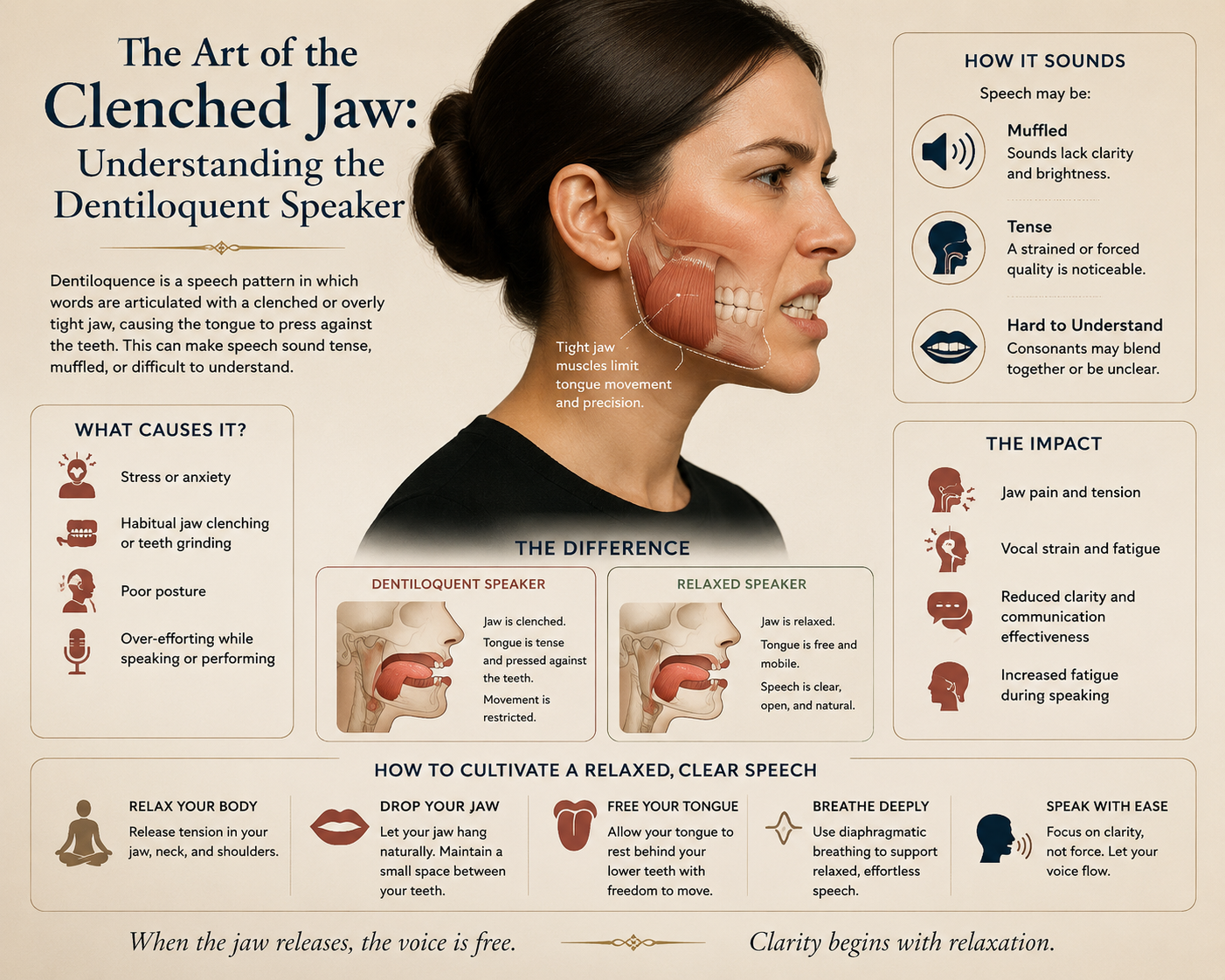
Have you ever been so angry that you could barely speak? You know the feeling: your jaw tightens, your teeth lock together, and words seem to escape through a narrow gap, sharp and strained. This universal human experience has a name that few know and even fewer can pronounce: dentiloquent.
Now picture this: a couple having a tense conversation in a quiet restaurant. Their words are polite, but something is off. Their voices are tight, their jaws barely moving, and they sound like they’re talking without opening their mouths. They are being dentiloquent—speaking through clenched teeth.
Dentiloquent is not just a word; it is a window into human emotions. It describes a very specific way of speaking—one that reveals more than the words themselves. It is the sound of barely suppressed anger, of forced patience, of a smile that doesn’t reach the eyes.
But is that all it is? Depending on who you ask, the meaning shifts slightly. While the dictionary definition is straightforward, the concept of “speaking through the teeth” has a few different flavors. This article will explore the authentic definition of dentiloquent, its actual origins, and how this rare and wonderful word is used in real life.
What Does “Dentiloquent” Really Mean?
At its core, dentiloquent is an adjective used to describe a person who speaks through their teeth or talks with their teeth closed. The noun form—dentiloquist—refers to the person doing the speaking.
In simpler terms, it means speaking with clenched teeth or a tense jaw. It often suggests the speaker is trying to control anger, frustration, or other strong emotions while still forcing words out.
Example Sentences
-
He responded in a dentiloquent tone, clearly trying to hide his irritation.
-
The manager gave a dentiloquent apology after the meeting became heated.
-
Her dentiloquent reply suggested she was trying hard not to lose her temper.
Different Interpretations
Interestingly, not everyone agrees on what a dentiloquist is. Most dictionaries and linguistic sources define a dentiloquist as simply a person who speaks through their teeth or with their teeth closed. However, some more niche definitions have emerged:
-
The Dental Definition: A term used in dentistry to refer to someone who can speak clearly while wearing dental appliances like dentures or braces.
-
The Comic Definition: A fictional character who speaks “with a moving of the teeth,” often used in satire or cartoons.
-
The Misinterpretation: Some sources define a dentiloquist as someone who talks to themselves, which appears to be a modern corruption or misunderstanding of the original term.
The Latin Roots of “Dentiloquent”
To truly understand a word, you have to look at where it comes from. “Dentiloquent” is a beautiful example of how language is built from smaller components.
The term comes from two Latin roots:
-
Denti-: Derived from dens, meaning “tooth” or “teeth.”
-
-loquent: From loqui, meaning “to speak” or “to talk.”
When you put them together, “dentiloquent” literally translates to “speaking through the teeth”. This is also the root for other words like eloquent (speaking out) or grandiloquent (speaking in a grand manner).
Why Latin?
Latin has been the foundation of scientific and literary language in the Western world for centuries. When lexicographers and scholars of the 18th and 19th centuries needed a new word to describe a specific phenomenon, they turned to Latin to create it. The word has been in use since at least 1834, as evidenced by a letter from John Fawcett mentioning that he had been “quite a dentiloquist”.
Why We Speak Through Clenched Teeth: The Psychology
Dentiloquent speech is almost never neutral. It is a physical manifestation of internal conflict. When we are unable to express our true feelings—whether out of politeness, fear, or self-preservation—our bodies often betray us.
The Physiology
When someone is angry or stressed, their body enters a state of “fight or flight.” The sympathetic nervous system kicks in, causing muscles to tense up. This includes the jaw muscles, particularly the masseter, which is the primary muscle used for chewing. A clenched jaw is therefore a sign of high tension.
The Psychology
The psychological meaning of speaking in a dentiloquent manner is one of suppression. It is the sound of a person trying to be polite when they want to scream, or trying to be professional when they want to argue. It is also a form of “faking it,” where the speaker tries to hide the obvious tension in their voice but is usually not entirely successful.
In Literature
Because it is a rare and evocative word, dentiloquent is a favorite tool for descriptive writers. It is used in literary writing, creative essays, and descriptive storytelling to add a layer of emotional depth and vivid imagery.
“His dentiloquent words hinted at frustration beneath his calm appearance”.
This single word tells the reader that the character is lying about their emotional state. It builds tension and subtext.
The “Dentiloquist” in the Real World
If you are looking for someone who fits the literal definition of a dentiloquist, look no further than a ventriloquist. Although ventriloquists are more associated with throwing their voice, they often achieve this effect by speaking with minimal lip movement, essentially talking through their teeth.
The Clenched-Jaw Executive
Imagine a boardroom where a CEO is announcing disappointing earnings. The executive says, “We had a difficult quarter,” but you can hear the strain in their voice. Their jaw is tight, and their teeth are nearly locked. They are afraid of showing weakness, so they clamp down on their words. They are speaking dentiloquently.
The Passive-Aggressive Partner
A classic domestic scene: a couple is in the car, arguing. One says, “I’m not angry,” but their tone is a giveaway. They are talking through their teeth, and the other person knows it. The dentiloquent tone is a nonverbal cue that betrays the intended message.
The Comedic Dentiloquist
In fiction, particularly in cartoons or satire, the dentiloquist might be a character who speaks through their teeth for comedic effect. Think of a villain giving a threat or a character trying to maintain a polite facade in an absurd situation. However, as mentioned, some sources define this comedic version as a “fictional character who speaks with a moving of the teeth,” which is a slight variation on the standard definition.
How to Use This Word in Your Writing
Since it is rare, using the word “dentiloquent” is a great way to impress your readers, but it has to be used correctly. Here are some tips for weaving it into your daily life or your next writing project.
How to Use It in Everyday Conversations
Even though it’s a rare word, you can use it in casual or professional settings, especially if you are looking for a precise vocabulary.
-
In a heated debate: “I could tell by his dentiloquent tone that he was holding back.”
-
Describing someone: “She is the most dentiloquent person I know; she never says what she actually feels.”
-
The verb form: While “dentiloquent” is an adjective, you can use it descriptively, e.g., “He dentiloquently muttered his reply.”
How to Use It in Writing
-
Descriptive Storytelling: Use it to describe a character’s dialogue when they are in a state of high stress or anger.
-
Creative Essays: Use it to describe a specific moment of social tension.
-
Tips:
-
Don’t overuse it; it is a spice, not a staple.
-
Make sure the context is clear. Because the word is rare, the reader might not know the meaning immediately.
-
Pair it with physical descriptors. Instead of simply saying, “He was dentiloquent,” say, “His jaw tightened, and his response was distinctly dentiloquent.”
-
Common Misconceptions
1. It Only Relates to Dentistry
Some sources define “dentiloquent” specifically as the ability to speak clearly regarding dental health or while wearing dental appliances. While this is a plausible modern usage for the medical field, it is not the original or most common dictionary definition. The primary meaning remains to speak through closed teeth.
2. It Means Talking to Yourself
One online source, Pronounce Online, defines a dentiloquist as someone who talks to themselves. This appears to be an error or a very niche, specialized meaning. Most major dictionaries and etymology sources, such as Webster’s Revised Unabridged Dictionary and Word Info, define the term as “one who speaks through the teeth”. It is best to avoid this self-talk definition in favor of the more widely accepted one.
Pros, Cons, and a Balanced Analysis
While “dentiloquent” is just a word, understanding its meaning comes with certain benefits and drawbacks.
Pros of Knowing This Word
-
Better Communication: You are better equipped to describe a specific behavior. Rather than saying “he sounded angry,” you can say “his tone was dentiloquent,” which conveys a more nuanced meaning—that he is suppressing the anger.
-
Vocabulary Expansion: It is an obscure and interesting word that can make you sound more intelligent and articulate.
-
Richer Writing: It gives you a precise tool for descriptive storytelling.
Cons of Knowing This Word
-
Misunderstanding: Because it is a rare word, you may have to explain it to your audience. Using it in conversation might cause confusion rather than clarity.
-
Pretentiousness: Using obscure words can sometimes make you sound pretentious or like you are trying too hard.
Balanced Analysis
Does “dentiloquent” deserve a place in our everyday vocabulary? Probably not, but it is a magnificent word for specific contexts. Its value lies in its precision. Just as we have words like laconic (using very few words) or verbose (using too many), having a word for “speaking through clenched teeth” fills a linguistic gap. It is a word for writers, for psychologists, and for anyone who pays close attention to how people speak.
Conclusion: The Power of a Single Word
“Dentiloquent” is a testament to the richness of the English language. It is a word that describes a universal human experience in a unique and efficient way. It captures the tension, the effort, and the suppressed emotion that accompany the act of speaking when you want to do anything but. It is a word that lets you see the hidden war behind a calm facade—the war between what you feel and what you are allowed to say.
Key Takeaways
-
Definition: Dentiloquent means speaking through clenched teeth, often due to anger or tension.
-
Origin: Derived from the Latin dens (tooth) and loqui (to speak).
-
Usage: Used primarily in literature and descriptive writing to convey suppressed emotion.
-
Related Terms: Dentiloquist (the speaker), Dentiloquence (the act of speaking).
-
Misconception: It is not exclusively about dentistry or talking to oneself, despite some niche definitions.
-
Value: It provides a precise tool for describing a specific and common type of communication, enriching our understanding of human interaction.