
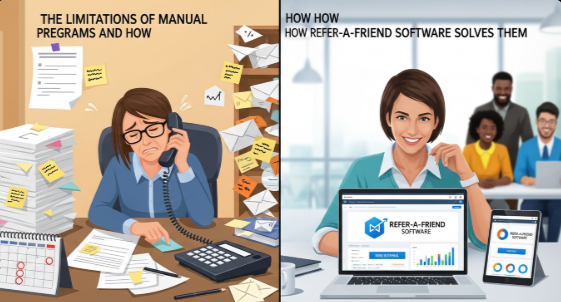
Word of mouth is the oldest trick in the book, but relying on static Google Sheets and manual coupon emails in 2026 can, more often that not, lead to broken attribution and rampant reward fraud.
Many brands start their referral journey with a simple “tell a friend” in an email. If you still manually track who referred who over time, you will likely end up with lost data and burnt-out operations teams.
The moment your program starts actually working is usually the exact time your manual process starts failing.
Relying on the refer-a-friend software setup is more than a technical upgrade. It’s a way to finally give your fans a way to advocate for you without the process falling apart once you hit 50 orders.
Why Manual Referral Programs Break at Scale
As your volume of advocates grows, human-led processes become a bottleneck that prevents the program from contributing meaningful revenue.
When you have ten referrals a month, you can handle them. When you have a thousand, you’re in trouble.
Manual programs are fragile because they require people at every step. It’s unrealistic to expect a marketing manager to spend hours checking spreadsheets to confirm one referral.
The breakage usually happens in the gaps between departments:
- Marketing wants more leads
- CS is tired of answering reward-related emails
- Finance is worried about double-counting discounts
The reality is that about 62% of marketing teams lose leads simply because their data is a disaster. Without a centralised referral platform to pull it all together, everyone ends up working in their own little bubble, relying on outdated info that doesn’t show how the program is actually performing.
If you’re not automating, your staff likely spends 30% more time on admin tasks that a script could do in seconds. That’s 30% of a salary spent copy-pasting voucher codes into Outlook.
Lack of Visibility and Attribution in Manual Referral Tracking
The biggest hurdle in a manual setup is the black hole of data, where you can’t prove which customer actually drove a specific sale.
How do you actually know where a customer came from? In a manual world, you’re often relying on “How did you hear about us?” dropdown menus or checkout notes. Those forms are where data goes to die. Half the people skip them, and the other half just click the first option to get to the checkout faster.
Relying on manual tracking is notoriously unreliable because:
- Customers forget names or spell them wrong
- The timing is hard to track
- Only the last click is noticed
- You don’t see social shares
Not knowing your referral sources is expensive. Referral leads convert five times better than cold clicks, so missing this data means you lose out on extra revenue and can’t focus on what works.
Without dedicated refer-a-friend software, you can’t see the social advocacy map. You observe the final sale but miss the five people who clicked the link but didn’t buy — valuable data to help tweak your messaging. Maybe your landing page is too slow, or your offer isn’t punchy enough, but without software, you can only guess.
Operational Inefficiencies and Workflow Bottlenecks
Manual programs don’t just slow you down; they also hurt morale. You pay skilled people to spend time cleaning up leaked code online.
We’ve all seen interns spend half their week playing whack-a-mole with discount links on Reddit instead of doing something that supports the business.
Think about the steps required to fulfil a single referral manually:
| Action Item | Manual Effort | Referral Platform |
| Reward creation | Generating unique codes one-by-one | Automated API generation |
| Verification | Checking if the friend is a new customer | Instant database cross-referencing |
| Distribution | Emailing individual codes | Trigger-based instant delivery |
| Tracking | Updating a master spreadsheet | Real-time dashboard updates |
These bottlenecks slow you down and stop you from launching new campaigns because the admin tax is simply too high.
You might have a great idea for a double-reward weekend, but then you realise your team would have to manually process twice the volume, and suddenly the idea gets shelved. That’s a missed opportunity for a massive revenue spike, all because of a spreadsheet.
Inconsistent Customer Experience and Missed Referral Opportunities
Without automation, there can be a long delay between a friend making a purchase and the advocate getting a thank-you, which can hurt your brand’s momentum.
A referral is a high-intent moment. If a customer recommends your brand, they are putting their reputation on the line. If the friend they referred has a clunky experience, like a code that doesn’t work or a confusing landing page, it reflects poorly on the advocate.
Manual setups often miss the best timing. Without refer-a-friend software, you’re likely to miss the ideal moment to ask for a referral, such as after a:
- 5-star review
- Successful delivery
- Repeat purchase
This happens when your CRM and referral tracker don’t work together.
The ask needs to happen when the customer is actually feeling the love, not three weeks later when you finally get around to sending a batch email.
Limited Ability to Optimise and Scale Performance
When your data is stored in a static file, you miss the chance to adjust your strategy in response to real-time customer behaviour and conversion trends.
If you can’t measure it, you can’t improve it. Manual programs give you a lagging indicator. You know how many rewards you gave out last month, but you don’t know the conversion rate of your referral landing page.
Using a referral platform allows for A/B testing that is impossible to do by hand:
- Testing different reward values
- Experimenting with copy and imagery
- Segmenting offers by customer lifetime value
- Adjusting the ask based on the device used
What if $10 off works better than 15%? You’ll never know if you’re locked into one manual code for everyone.
Refer-a-friend software lets you run these experiments in the background, constantly squeezing more ROI out of the same amount of traffic without you lifting a finger.
Fraud Risk and Lack of Quality Control
Manual systems are prime targets for exploiters because no real-time checks stop people from referring themselves via burnable emails. People like free stuff. If your referral program is easy to game, people will do so. Entire forums exist to find ways to stack discounts on manual setups.
Manual programs are incredibly vulnerable to self-referral, where a customer uses a second email address to get a discount. Checking every order for fraud is a full-time job.
Refer-a-friend software builds in guardrails, like:
- IP filtering
- Cookie tracking
- Velocity checks
They ensure you pay only for genuine new customer acquisition. This way, your marketing budget goes toward finding new fans, not subsidising people who were already going to buy.
How Referral Marketing Software Solves Tracking and Attribution Gaps
Manual tracking always leaves a gap between your spreadsheet and what’s really happening. A referral platform solves this by giving each person a unique link that tracks them across sessions and devices. You get real, reliable data you can use.
When you use refer-a-friend software, you get a clear picture of your super-advocates—the 1% of customers who might be responsible for 40% of your referral revenue. You can’t find those people in a spreadsheet easily.
When you find these power-users, you can treat them like actual VIPs, maybe sending them a personalised gift or early access to a sale, turning a referral into a long-term partnership.
Automating Referral Workflows Across the Customer Lifecycle
By integrating with your existing tech stack, refer-a-friend software ensures that referral invites go out at the exact moment a customer is most likely to share.
Automation is basically the only way to stop the constant back-and-forth of running a program manually. Instead of you sitting there hitting “send” on a massive list, the platform just reacts to what your customers are actually doing.
Here’s what a referral platform allows:
- Post-purchase pop-ups
- Loyalty portal integration
- NPS-triggered invites
- Delayed rewards for subscription models
The whole process runs automatically in the background, bringing in leads while you focus on your main work.
Enabling Data-Driven Optimisation and Incrementality Measurement
A referral platform gives you the tools to prove that your referral sales are truly new business, rather than just discounted sales from existing fans.
One of the biggest questions the finance team will ask is: “Would these customers have bought anyway?”
Sophisticated refer-a-friend software helps you measure incrementality. By using control groups, you can see the true lift your referral program provides compared to your baseline organic traffic.
If you look at the numbers, a referral program isn’t just a line item in your marketing budget. It’s actually an engine for making money.
From Manual Processes to Scalable Referral Infrastructure
Most companies treat referrals as a messy experiment they check on once a month. Moving to a real infrastructure changes that. It takes what was once a manual side project and turns it into a predictable, automated part of how you actually grow.
Retiring manual processes is a rite of passage for growing brands. It’s about building a foundation that can support 10,000 referrals as easily as 10.
By implementing a referral platform, you’re not just buying a tool. You’re investing in a channel that typically has a higher conversion rate and lower CPA than paid social or search.