
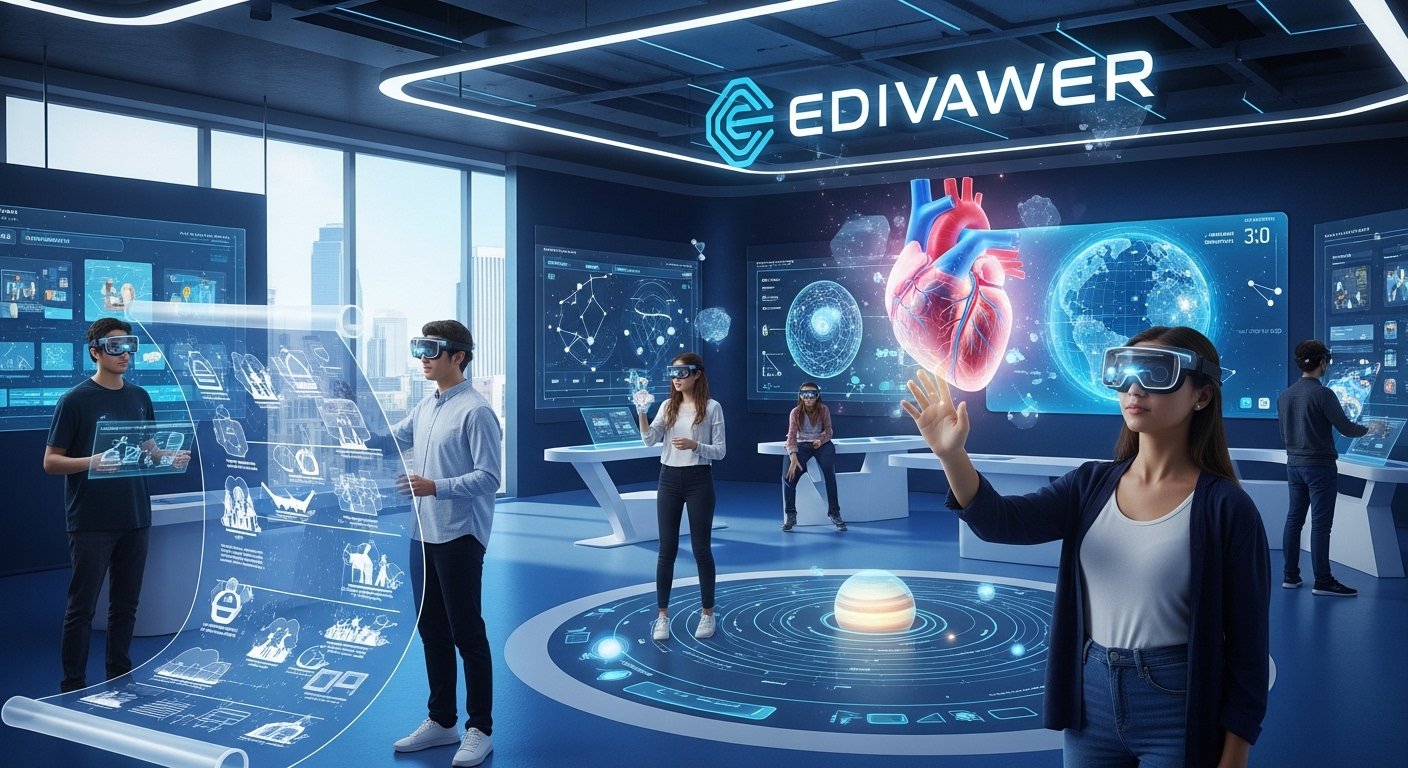
The first time a classroom dissolved into a living, breathing ecosystem, it wasn’t inside a school—it was inside a headset. A student stood at the edge of a simulated rainforest, listening to the hum of insects, watching the delicate interplay of light and leaves, and understanding biodiversity not as a paragraph in a textbook, but as an experience. This is the quiet revolution shaping education today. At the center of this shift is Edivawer, a concept that is steadily redefining how knowledge is delivered, consumed, and remembered.
Edivawer represents more than a tool or a platform. It is an emerging philosophy of immersive digital learning—one that prioritizes interaction, personalization, and presence over passive consumption. As industries evolve and attention spans fragment, the traditional classroom model struggles to keep pace. Edivawer steps into this gap, offering a future where learning is not just seen or heard, but deeply felt.
From Static Content to Living Experiences
For decades, education has been built on static mediums books, slides, lectures. While these formats have their strengths, they often fail to capture the dynamic nature of real-world systems. Edivawer challenges this limitation by turning abstract concepts into interactive environments.
Imagine learning physics by manipulating gravity in real time, or understanding history by walking through digitally reconstructed civilizations. These experiences move beyond memorization. They create cognitive anchors—moments that the brain can revisit and reconstruct with clarity. The result is not just better retention, but deeper comprehension.
What makes this approach powerful is its alignment with how humans naturally learn. We are experiential beings. We learn by doing, by observing, by engaging with our surroundings. Edivawer leverages this instinct, translating it into a digital context that is both scalable and adaptable.
The Technology Behind Edivawer
At its core, Edivawer is powered by a convergence of technologies that were once considered futuristic. Virtual reality (VR), augmented reality (AR), artificial intelligence, and real-time data processing all play a role in creating immersive learning environments.
Artificial intelligence, in particular, adds a layer of personalization that traditional systems cannot match. Instead of a one-size-fits-all curriculum, learners are guided through adaptive pathways tailored to their pace, strengths, and gaps. The system learns alongside the student, adjusting difficulty, recommending resources, and even predicting areas where additional support may be needed.
Meanwhile, AR and VR technologies create the spatial dimension that makes learning tangible. They allow learners to step inside the subject matter, transforming passive observation into active participation. This is where Edivawer distinguishes itself—not as a digital upgrade, but as a complete reimagining of educational interaction.
Why Immersion Matters More Than Ever
In an age of constant distraction, capturing attention is half the battle. Retaining it is the other half. Edivawer addresses both challenges by creating environments that demand presence. When learners are immersed, they are less likely to disengage. The experience becomes self-sustaining.
This has profound implications for industries beyond traditional education. Corporate training, healthcare simulations, and technical skill development all benefit from immersive learning models. A medical student practicing surgery in a risk-free virtual environment, or an engineer troubleshooting a complex system in a simulated setting, gains practical experience without real-world consequences.
The value here is not just efficiency—it is confidence. When learners can practice repeatedly in a controlled environment, they build competence that translates seamlessly into real-world performance.
Bridging the Gap Between Theory and Practice
One of the longstanding criticisms of conventional education is the disconnect between theory and application. Students often struggle to see how abstract concepts apply to real-world scenarios. Edivawer closes this gap by embedding theory within context.
Instead of learning formulas in isolation, learners apply them within simulated environments. Instead of reading case studies, they participate in them. This shift transforms learning from a linear process into a multidimensional experience.
The impact is particularly significant for fields that require hands-on expertise. Technical education, vocational training, and STEM disciplines all stand to benefit from this approach. By the time learners encounter real-world challenges, they have already navigated similar scenarios in a virtual space.
A Comparative Look at Learning Models
To understand the transformative potential of Edivawer, it helps to compare it with traditional and digital learning approaches.
| Feature | Traditional Learning | Standard Digital Learning | Edivawer Immersive Learning |
|---|---|---|---|
| Engagement Level | Moderate | Variable | High |
| Personalization | Limited | Basic | Advanced (AI-driven) |
| Practical Application | Low | Moderate | High |
| Retention Rate | Moderate | Moderate | High |
| Interactivity | Low | Medium | Very High |
| Real-World Simulation | Minimal | Limited | Extensive |
This comparison highlights a fundamental shift. Edivawer is not simply an evolution of digital learning—it is a departure from it. It introduces a level of engagement and realism that previous models could not achieve.
Challenges on the Path Forward
Despite its promise, Edivawer is not without challenges. Accessibility remains a key concern. High-quality immersive experiences often require advanced hardware, which may not be readily available in all regions. Bridging this digital divide will be critical to ensuring that the benefits of immersive learning are widely distributed.
There is also the question of content creation. Designing immersive environments requires a different skill set compared to traditional educational materials. It involves collaboration between educators, developers, designers, and subject matter experts. This complexity can slow adoption, particularly in institutions that are resistant to change.
Additionally, there are concerns around cognitive overload. While immersion can enhance learning, excessive stimulation may have the opposite effect. Striking the right balance between engagement and clarity will be essential as Edivawer continues to evolve.
The Role of Educators in an Edivawer World
Contrary to common fears, Edivawer does not replace educators it redefines their role. Teachers become facilitators, guides, and designers of learning experiences rather than mere transmitters of information.
This shift empowers educators to focus on higher-value interactions. Instead of repeating the same lecture, they can spend more time mentoring, providing feedback, and fostering critical thinking. The technology handles the delivery of content, while the educator shapes the learning journey.
In this sense, Edivawer enhances the human element of education rather than diminishing it. It creates space for deeper connections between learners and mentors, even within a digital framework.
A Glimpse Into the Future
As technology continues to advance, the possibilities for Edivawer expand. Haptic feedback could allow learners to feel virtual objects. Neural interfaces may one day enable direct interaction with digital environments. While these developments are still emerging, they point toward a future where the boundaries between physical and digital learning blur even further.
What remains constant, however, is the underlying goal: to make learning more meaningful, more effective, and more accessible. Edivawer is not just about innovation for its own sake. It is about aligning education with the realities of a rapidly changing world.
Conclusion:
The most powerful learning experiences are the ones that linger—the moments that reshape how we see the world. Edivawer taps into this idea by turning education into an experience rather than a task.
As organizations, educators, and learners navigate this evolving landscape, the question is no longer whether immersive learning will become mainstream, but how quickly it will redefine our expectations.